It’s a cold Monday morning on the Downtown Connector, just past the I-20 interchange. Traffic is moving, then crawling, then moving again. Heading north toward Downtown, you feel a heavy thump-thump under the car and the steering wheel starts pulling to the right. The tire pressure light comes on. Cars are passing on both sides, and the shoulder suddenly looks very narrow.
Short answer: Hold the wheel straight, ease off the gas without slamming the brakes, signal, and move to the right shoulder or the next exit. Turn on your hazard lights and call (470) 487-8492. If the shoulder is narrow or traffic is fast, don’t change the tire yourself. Stay buckled in the car, or behind the guardrail if it’s safe to get out, and let us handle the tire change.
How to Tell You Have a Flat While Driving
A flat doesn’t always announce itself with a loud bang. Often it starts quietly and gets worse over a mile or two. Watch for these signs:
- The car pulls to one side. You have to hold the wheel harder than usual just to stay in your lane.
- A thumping or flapping sound. It gets faster as you speed up and slower as you slow down.
- A shaky, wobbly ride. The steering wheel or the whole car vibrates more than the road surface explains.
- The tire pressure warning light. A horseshoe-shaped symbol with an exclamation point means at least one tire is low.
- Other drivers waving or pointing. Sometimes they can see a low tire before you can feel it.
A sudden blowout feels different. You hear a loud bang and the car jerks hard toward the flat side. The steps below are the same, but staying calm and holding the wheel steady matters even more.
What to Do Right Away, Step by Step
- Hold the wheel firmly and keep it straight. Don’t jerk it toward the shoulder. Small, steady moves keep the car under control.
- Ease off the gas. Let the car slow down on its own at first. Hard braking on a flat can make the car swerve.
- Signal and move right. Once you’ve slowed down, signal and work your way to the right shoulder. If an exit is very close, rolling slowly to the end of the ramp or into a parking lot is often safer than a narrow shoulder.
- Stop as far from traffic as you can. Pull fully onto the shoulder, away from the white line, and avoid stopping on a curve or right over a hill where drivers can’t see you.
- Turn on your hazard lights. At night, leave your parking lights on too.
- Decide where to wait. On a busy interstate, staying inside with your seat belt on is often the safest choice. If there’s a guardrail and you can get out on the side away from traffic, waiting behind the guardrail is another option.
- Call us. Call (470) 487-8492 and tell us the road, the direction, the nearest exit and what you drive. If anyone is hurt or the car is stuck in a travel lane, call 911 first.
Should You Change the Tire Yourself on an Atlanta Interstate?
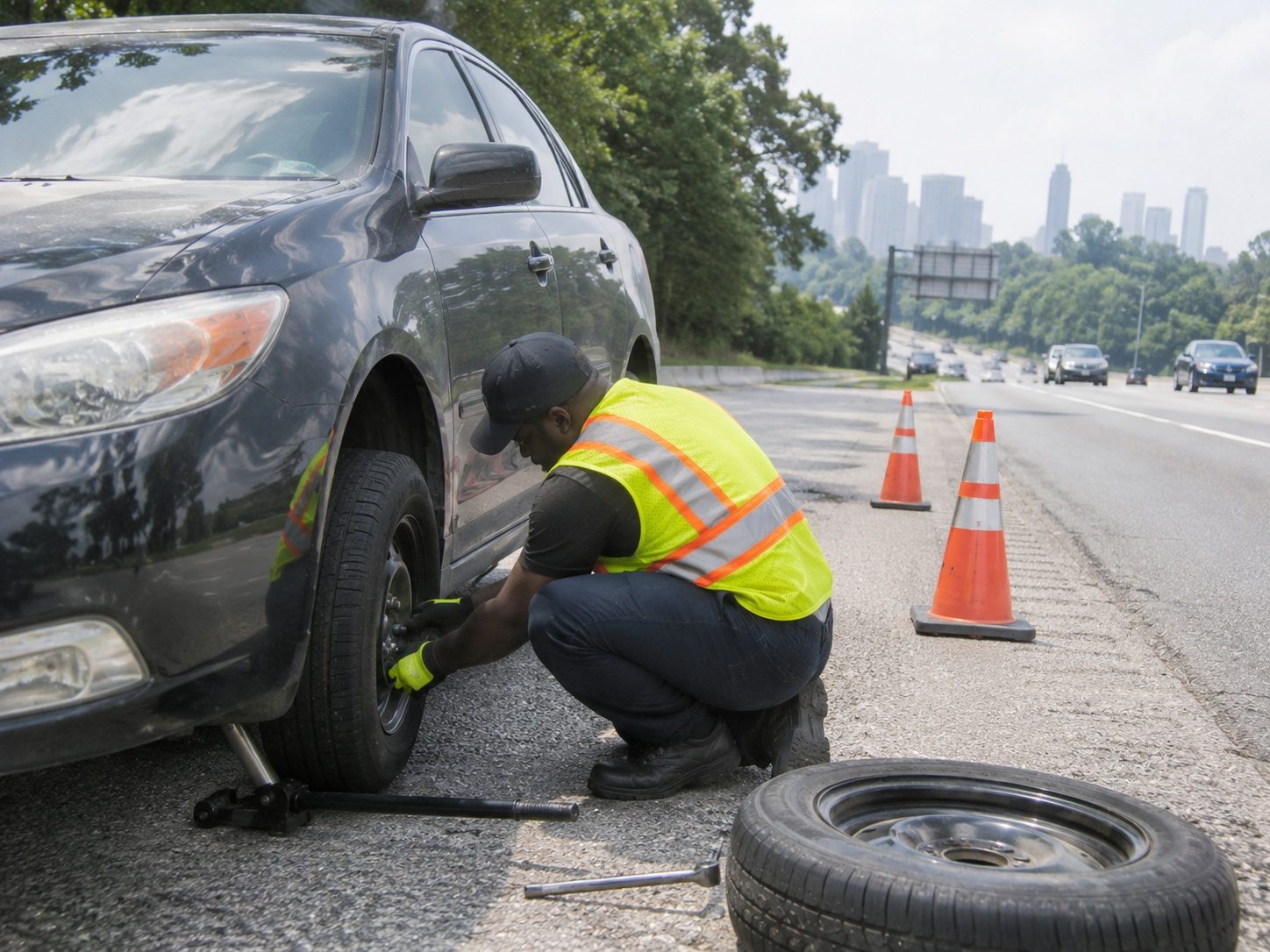
Changing a tire is a skill worth knowing, but the side of a busy interstate is a hard place to use it. On roads like the Downtown Connector, I-20, I-75 and I-85, the shoulder can be narrow, traffic is heavy most of the day, and many drivers are looking at their phones or their exit signs. If the flat tire is on the traffic side, you’d be kneeling a few feet from cars going highway speed.
Georgia has a Move Over law that tells drivers to change lanes, or slow down if they can’t, when they pass stopped emergency vehicles and tow trucks with their lights flashing. That helps protect the crew working on your car. But not every driver pays attention, so the safest plan is still to keep people out of the space next to traffic.
If you’re in a quiet parking lot, a side street in Mechanicsville or your own driveway, changing it yourself can be fine. If you’re on a narrow shoulder, the light is fading or you’re not sure where the jack goes, call (470) 487-8492. That’s exactly what our roadside assistance is for.
Can You Drive on a Flat Tire?
Only as far as you need to get out of danger, and only very slowly. A tire with no air lets the wheel rim press against the rubber and sometimes against the road. A few hundred feet to reach a safe exit ramp is one thing. A few miles at normal speed can shred the tire, bend the rim and damage parts around the wheel, which turns a simple tire change into a much bigger bill.
What you can drive on after the flat depends on what your car has. Here is a quick guide:
| What you have | Can you drive on it? | What to keep in mind |
|---|---|---|
| A flat tire with no spare on | Only a short, slow roll to get out of traffic | Driving farther can ruin the rim and the tire. Stop as soon as you’re somewhere safe. |
| Full-size spare | Yes, like a normal tire | Check its air pressure first. Spares often sit low for years without anyone noticing. |
| Compact spare (the small “donut”) | Yes, but slower and shorter trips | Read the label on the spare or your owner’s manual. Many say 50 mph or less, and only far enough to get the flat repaired. |
| Run-flat tires | For a limited distance at reduced speed | The limits are set by the tire maker and are in your owner’s manual. Most cars with run-flats have no spare at all. |
| Tire sealant kit | Sometimes, for a small puncture in the tread | It won’t fix a torn sidewall or a blowout. Many shops want to know if sealant was used. |
| No spare, or the spare is flat too | No | Call for a tow to a tire shop. A flatbed tow keeps the damaged wheel off the road. |
Not sure what kind of spare you have? Look under the floor of the trunk or cargo area, and check under the back of the car on many trucks and SUVs. If you can’t find one, tell us when you call so we can plan for a tow instead of a tire change.
Why Flats and Low Tire Warnings Show Up in Late Fall
Many Atlanta drivers notice the tire pressure light for the first time on a chilly November morning. That’s not bad luck. Air shrinks when it gets cold, so tire pressure drops as the temperature falls, often about one pound per square inch for every 10 degrees. A tire that was a little low in October can drop below the warning level on the first cold morning, and the light may go off again once the tires warm up from driving.
A tire that’s low on air flexes more and builds up heat, and that makes it more likely to fail on a long drive. Add the holiday travel season, construction zones with loose debris, and potholes after a rainy week, and late fall is a good time to give your tires some attention.
- Check your tire pressure when the tires are cold, before you drive, using the number on the sticker inside the driver’s door.
- Check the spare too. A flat spare doesn’t help anyone.
- Look for nails, screws, bulges or cracks in the sidewall.
- Make sure you know where the jack, the lug wrench and the wheel lock key are kept.
- If the warning light stays on after the tires are filled, have a shop look at it.
What to Tell Us When You Call
A few details help us find you fast and bring the right equipment. On the interstate, the exact spot matters most:
- The road and the direction you were heading, for example I-75/85 northbound or I-20 eastbound.
- The last exit you passed or the next one ahead, a mile marker sign, or a landmark you can see.
- Whether you’re on the right shoulder, the left shoulder or off the highway on a ramp or side street.
- Your vehicle’s year, make and model, and which tire is flat.
- Whether you have a spare and where it is, and whether the wheels have a locking lug nut with a key.
- Whether the wheel or rim looks damaged, or more than one tire is flat.
If you’re not sure where you are, open the map app on your phone and read us the nearest road or business name. That’s often enough.
Tire Change or Tow: Which One Do You Need?
Most flats only need a tire change. We take off the flat and put on your spare so you can drive to a tire shop. But a tow makes more sense when:
- There’s no spare, or the spare is flat or damaged too.
- More than one tire is flat.
- The wheel lock key is missing, or the lug nuts are stuck.
- The rim, the suspension or the body around the wheel is damaged.
- The car has run-flat tires with no spare and the tire is past its limit.
For most cars, SUVs and pickups, that means light duty towing to a tire shop or your home. A flatbed carries the whole vehicle off the ground, so a damaged wheel doesn’t touch the road on the way. For box trucks, work vans and larger vehicles, we also offer medium duty and heavy duty towing. Tell us what you see, and we’ll help you choose on the phone.
In Mechanicsville and Around Atlanta
Mechanicsville sits right next to our shop, just southwest of Downtown, with the Downtown Connector on one side and I-20 close by. A lot of the flats we hear about start on those two highways or on the busy streets that feed them, like McDaniel Street and Ralph David Abernathy Boulevard. If you can roll slowly off the highway and onto a quiet side street, that’s often the safest place to wait.
We also help drivers in Summerhill, Grant Park and Downtown Atlanta, plus Peoplestown, West End, Castleberry Hill, Old Fourth Ward, Inman Park and Midtown. Before a long holiday drive, Georgia DOT’s 511GA shows traffic, crashes and lane closures on the roads ahead, so you can plan around the slow spots.
Frequently Asked Questions
Can I drive on a flat tire to the next exit?
Only if the exit is very close and you go very slowly with your hazard lights on. Driving farther on a flat can ruin the rim and the tire. If the exit is far away, stop on the shoulder as far from traffic as you can and call (470) 487-8492.
How far can I drive on a spare tire?
A full-size spare works like a normal tire once it has the right air pressure. A compact spare, the small “donut”, is only meant to get you to a tire shop. Check the label on the spare or your owner’s manual for its speed and distance limits; many say 50 mph or less.
Why does my tire pressure light come on when it gets cold?
Cold air takes up less space, so tire pressure drops when the temperature falls. A tire that was slightly low can go under the warning level on a cold morning. Fill the tires to the number on the sticker inside the driver’s door, and have a shop check them if the light stays on.
What if I don’t have a spare or the wheel lock key?
Then a tire change won’t work, but a tow will. Call (470) 487-8492, tell us what’s missing, and we’ll tow the car to a tire shop or your home. If the car has run-flat tires, check your owner’s manual for how far you can go on them.
What are your hours?
We’re available day and night. Our regular hours are 8 AM to 11 PM, every day, the same as our Google listing, and we’re often out earlier and later too, depending on the day. Call (470) 487-8492 any time and we’ll tell you how soon we can be there.
Got a flat on the Connector, I-20 or a street around Downtown? Call Mound Lift Towing Company at (470) 487-8492. We’ll help you get safe, change the tire or tow the car, and get you back on the road.